App Facts
- App
- Online Chess App Guide India: Fair Play, Privacy, and Safety Checks
- Rating
- 3.7/5
- Type
- Casual Games
- Downloads
- Use the official website or app-store listing only; avoid unofficial APK mirrors and modified clients.
Online chess looks lower-risk than cash-first gaming apps, but Indian players should still check fair-play rules, account privacy, tournament terms, and the current online-gaming context before relying on an app. This guide is based on public sources and is not a hands-on test of Chess.com, app permissions, payments, support, KYC, withdrawals, or gameplay.
The useful question is not only whether a chess app lets you play. A safer review asks how the app treats outside assistance, what happens if a fair-play dispute appears, what personal data the account may collect, and whether any contest, prize, entry fee, or promotion changes the risk profile. For wider mobile-app checks, compare this with our gaming app data safety checklist for Indian players.
Quick Verdict
- Best fit: players who want casual games, practice, puzzles, ratings, or supervised chess events where the rules are visible before play.
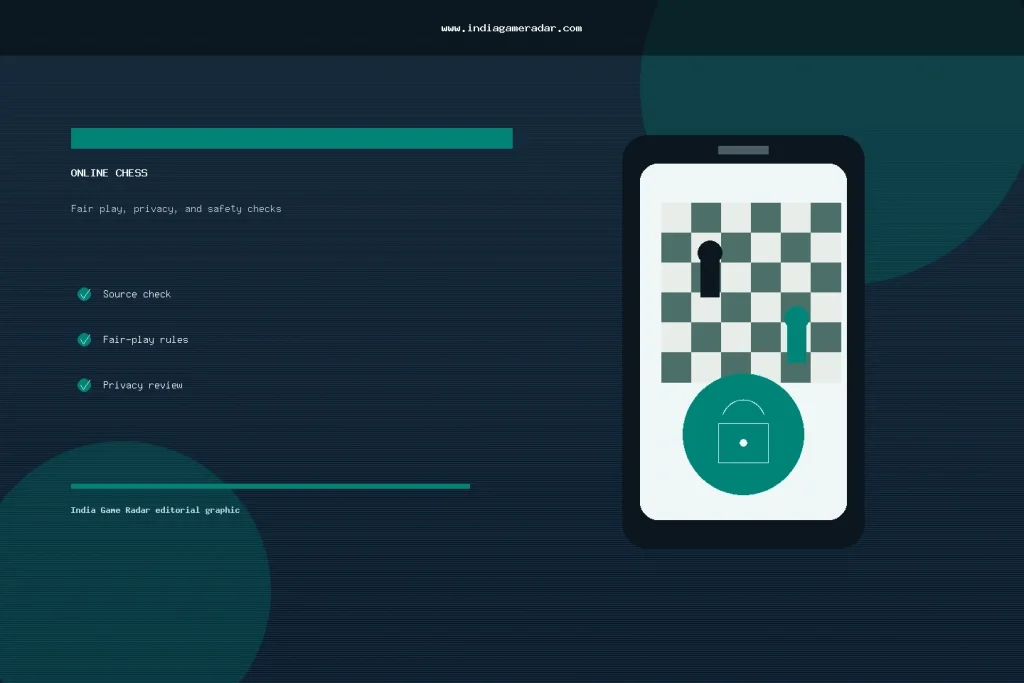
- Main checks: fair-play policy, account security, privacy policy, event rules, refund or subscription terms, and support routes.
- Higher-risk situations: entry-fee contests, prize competitions, third-party tournament links, unofficial APKs, shared accounts, or advice that tells you to use engines during live play.
- Editorial limit: India Game Radar is an independent information site. We do not operate chess games, process deposits, handle withdrawals, manage accounts, or approve any platform.

Fair Play Comes First
Any serious online chess app should make fair-play boundaries easy to find. The Chess.com Fair Play Policy explains restrictions around outside help, engines, bots, account sharing, rating manipulation, automated analysis during games, and player reporting. Those rules matter because online chess can be damaged quickly when players use software help or allow someone else to play from the same account.
For Indian players, the local chess context also matters. The All India Chess Federation has published fair-play complaint instructions for online national championships, including details a player may need to submit and how an appeal can be assessed. That does not mean every private app or casual room follows the same process. It does show why evidence, timestamps, game links, and event rules are important when a player suspects cheating.
A practical rule is simple: if an app or event does not explain fair-play review, reporting, account penalties, and appeal routes, treat prize claims and competitive rankings cautiously. Do not respond to suspected cheating by using an engine yourself. Save the game link, screenshot the event room or match details, and use the platform’s reporting route.
Privacy And Account Checks
Chess accounts can still involve personal data. Before installing or registering, read the Chess.com Privacy Policy or the privacy policy for whichever app you use. Look for the basics: username, email, phone-number prompts, purchase or subscription information, device identifiers, cookies, analytics, account deletion, and the privacy rights available in your jurisdiction.
On mobile, privacy also includes permissions. A chess app should not need broad access that feels unrelated to play. Be careful with unofficial APK mirrors, modified clients, plug-ins that promise rating boosts, or browser extensions that claim to help during live games. Those tools may create both privacy risk and fair-play risk.

India 2026 Online-Gaming Context
The online-gaming context in India changed in 2026, so chess players should separate ordinary social play from any money-linked contest. The PIB note on the Promotion and Regulation of Online Gaming Rules, 2026 describes an official framework for distinguishing prohibited online money games from permissible online social games or e-sports, plus user-safety, transparency, grievance, and registration obligations for relevant providers.
This article does not decide the legal status of a specific chess event. Instead, use the rules as a checklist trigger. If an app adds deposits, entry fees, paid tournament pools, sponsored prizes, or third-party payment flows, read the current terms before joining and avoid relying on advertising copy alone. If you only want casual play, puzzles, or training, you still need privacy and fair-play checks, but the money-game risk is usually a different question from ordinary chess practice.
Player Checklist Before You Play
- Use the official app store or official website. Avoid APK mirrors and modified clients.
- Read the fair-play policy before playing rated, prize, or tournament games.
- Check whether engines, databases, opening books, coaches, or outside help are allowed for your exact game mode.
- Review privacy settings, account deletion, purchase terms, and app permissions.
- Use a unique password and two-factor authentication when available.
- Save match links and event terms if you enter a tournament or suspect fair-play abuse.
- Check whether any contest involves money, prizes, entry fees, or third-party payments before joining.
- For low-stakes casual games, compare similar safety habits in our Ludo app guide for India and Carrom app guide for India.
Who Should Be Careful
Parents, students, rated players, and prize-event participants should be more cautious than casual puzzle users. A child account may need parental settings. A rated player needs clear fair-play boundaries. A prize-event participant needs written event terms and support details. A privacy-conscious user should check whether the app allows data access, correction, deletion, or account closure.
The safest choice is not always the app with the most features. It is the one where rules, privacy, reporting, and account controls are clear before you play. If those details are hidden, vague, or scattered across third-party pages, wait until you can verify them.
Bottom Line
An online chess app can be a useful place to practise and compete, but fair play and privacy are part of the product. Indian players should check the official app source, fair-play rules, privacy policy, event terms, and any money-linked features before treating an app as safe for regular use.
Casual chess play and training should be reviewed separately from money-linked contests. If a chess app or event involves entry fees, prizes, deposits, or third-party payments, check the latest platform terms and Indian online-gaming rules. This guide is not legal advice.
Do not use engines, bots, move calculators, or outside help during live or competitive games unless the exact game mode and platform rules clearly allow it. Many platforms treat that as a fair-play violation.
Check what account details are collected, whether phone or payment information is requested, what app permissions are enabled, how cookies or analytics are used, and whether account deletion or data-access options are available.
Save the game link, event details, screenshots, and timestamps, then use the app or organiser reporting route. Do not use an engine in response, because that can create a fair-play issue for your own account.
Important Notice
India Game Radar is an independent information website for adult readers. We do not operate betting or casino services, accept deposits, process withdrawals, manage player accounts, or provide access to real-money gaming. Always check official terms, local laws, and age requirements before using any third-party website.